

# Type Speed Test Calibration: Convert No Punctuation Scores Into Real Writing Speed
A type speed test without punctuation is useful for rhythm training, but it usually overstates the speed you can sustain in real writing. You can fix that by calibrating both test modes together. Run matched no punctuation and punctuation sessions, measure the gap, track correction cost, and use a simple conversion rule. This gives you a realistic WPM baseline for actual documents, chat, coding comments, and emails.
# Why punctuation changes your type speed test score so much
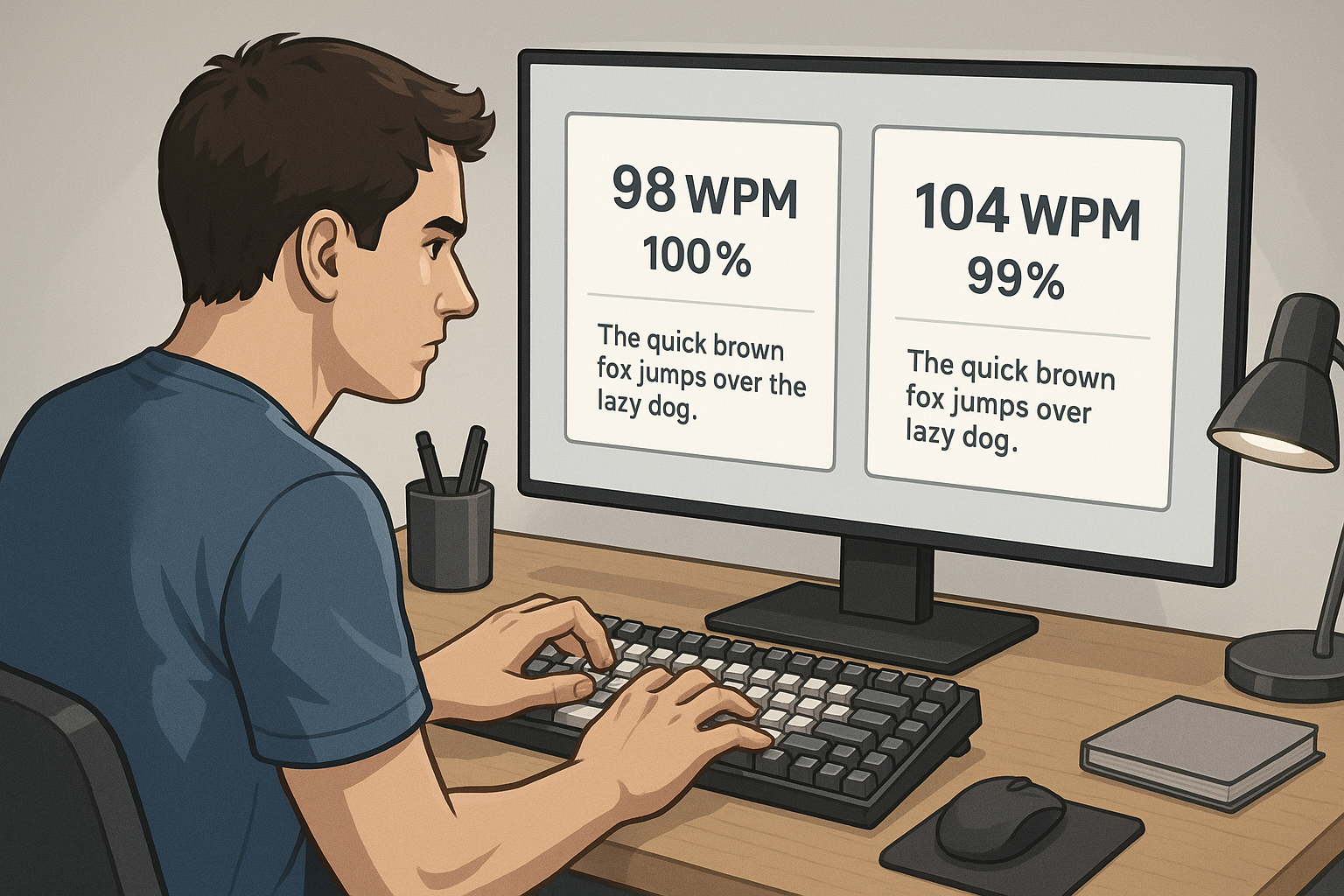
No punctuation passages reduce cognitive switching. You stay in a repeating letter flow, word boundaries are predictable, and you hit fewer symbols. Real writing inserts commas, periods, apostrophes, quotes, and occasional numbers. That changes three things at once.
First, travel path gets more complex. Symbol keys often sit on weaker finger lanes.
Second, decision load rises. You must decide punctuation timing while still planning the next words.
Third, correction pattern shifts. Punctuation mistakes create larger rewrites than a single letter slip.
This is not theoretical. Controlled typing studies consistently find that increased task complexity raises error rate and slows motor output because attention splits across more operations. That aligns with classic human performance work from NIST on text entry evaluation and broader skill acquisition literature from NIH indexed motor learning research.
The practical point is simple. A fast no punctuation run can still be valuable. You just need to interpret it as capacity, not final output.
# The calibration model: capacity speed vs production speed
Treat your score system as two layers.
- Capacity speed: no punctuation, rhythm focused, lower cognitive overhead.
- Production speed: punctuation on, realistic phrasing, correction included.
Both matter. Capacity speed tells you ceiling potential. Production speed tells you shipping speed, which is what matters for real tasks.
A useful conversion target is this:
production WPM = no punctuation WPM x conversion factor
For many typists, the conversion factor lands between 0.82 and 0.93. Beginners often sit near the lower end. Advanced typists with stable punctuation muscle memory move higher.
The mistake is using a fixed internet number. Your factor should come from your own sessions.
# Run a seven day paired test block
Use one short block that removes guessing.
Session design:
- 2 paired runs per day.
- Run A: no punctuation, same duration every day.
- Run B: punctuation enabled, same duration, same time of day if possible.
- Keep keyboard settings fixed during the block.
- Use one warmup run before recording data.
Recommended duration is 60 seconds because it balances stability with manageable fatigue. If you already train with 120 seconds, stay there for both modes.
Capture these metrics from each run:
- Raw WPM
- Accuracy percentage
- Error count or correction count
- Subjective effort from 1 to 5
Create a small log in your notes app or spreadsheet. You do not need advanced tooling. Consistency is the priority.
# Decision table: what your gap means and what to train next
Use this table after you collect at least five paired sessions.
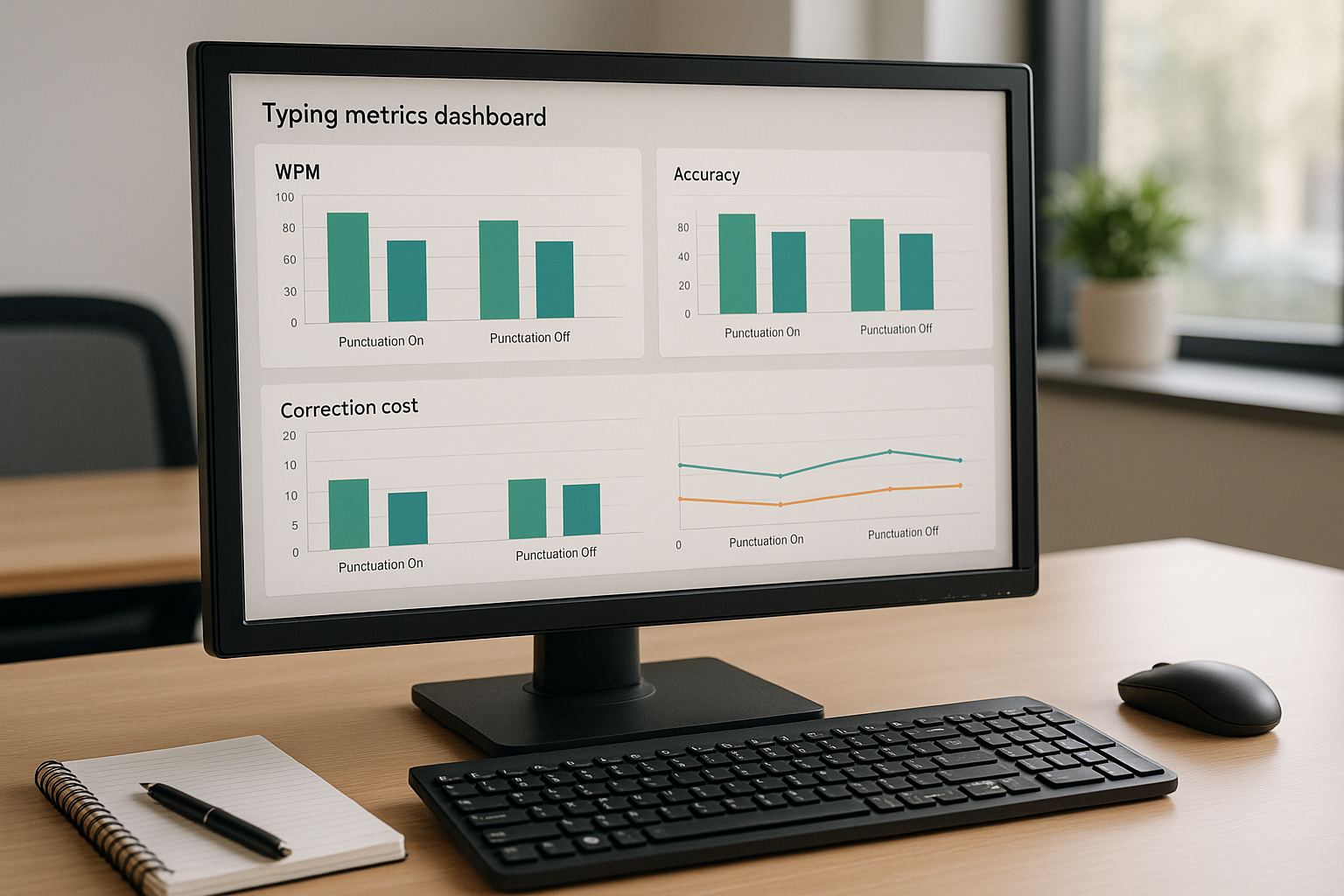
| Gap pattern | Typical cause | Highest leverage fix | Expected timeline |
|---|---|---|---|
| No punctuation is 15% to 22% higher | Symbol reach and shift timing weak | Punctuation micro drills with short burst intervals | 2 to 4 weeks |
| No punctuation is 10% to 14% higher | Mixed bottleneck, some rhythm issues | Alternate rhythm sets and punctuation sets in same session | 2 to 3 weeks |
| No punctuation is 6% to 9% higher | Strong transfer already | Maintain one calibration day each week | Ongoing |
| Gap changes wildly day to day | Setup inconsistency or fatigue swings | Standardize time, posture, keyboard mode, sleep window | 1 to 2 weeks |
If you want benchmark context for what counts as meaningful change, compare with TypeTest confidence interval guidance at /posts/2026-03-31-wpm-typing-test-confidence-intervals.html.
# Build your personal conversion factor
After seven days, compute:
- Average no punctuation WPM.
- Average punctuation WPM.
- Conversion factor = punctuation average divided by no punctuation average.
Example:
- No punctuation average: 86 WPM
- Punctuation average: 74 WPM
- Conversion factor: 74 / 86 = 0.86
Now when you hit 92 WPM in a speed focused run, your estimated production speed is 79 WPM.
92 x 0.86 = 79.1
This estimate is much more useful than celebrating the raw 92 alone. It helps with planning, workload timing, and realistic progress tracking.
# How to train the gap down without losing speed
You need targeted punctuation fluency, not endless long tests. Use a split practice structure.
# Block A: rhythm retention
- 4 to 6 runs
- No punctuation
- 30 to 60 seconds
- Goal: keep cadence smooth with minimal hesitations
This protects your motor speed ceiling.
# Block B: punctuation insertion
- 4 to 6 runs
- Punctuation enabled
- 30 to 60 seconds
- Goal: same rhythm as Block A with cleaner symbol execution
This builds transfer.
# Block C: mixed production simulation
- 2 to 3 runs
- Punctuation enabled, longer duration
- 90 to 120 seconds
- Goal: stable output under realistic fatigue
This reveals whether improvements survive beyond short bursts.
# Common calibration mistakes that hide real progress
# Mistake 1: changing keyboard settings mid block
If you alter polling rate, debounce, repeat delay, or layout during your measurement week, your factor becomes noisy. Finish the block first, then tune hardware.
# Mistake 2: comparing different durations
A 15 second no punctuation sprint and a 120 second punctuation run are not comparable. Keep duration matched when computing the factor.
# Mistake 3: using only best scores
Best run snapshots usually represent peak arousal and luck. Calibration should use averages, not highlights.
# Mistake 4: ignoring correction behavior
Two runs with equal WPM can have different real workload cost if one run has frequent backtracking. Track correction count and accuracy together.
# Mistake 5: over rotating to punctuation drills
If all training is complexity heavy, your base rhythm can decay. Keep at least one capacity block each session.
# A practical weekly template for students, developers, and office work
Use this as a starter and adjust based on your schedule.
Monday to Thursday:
- 15 to 20 minutes per day
- One short warmup
- Block A and Block B
- Log both mode averages
Friday:
- 20 to 25 minutes
- Add Block C for longer realistic runs
- Recompute weekly factor
Weekend:
- One light check session or full rest
- Review trend, adjust next week focus
This structure works well because it separates skill development from evaluation. If you train daily but measure only occasionally, you may miss drift. If you measure constantly without focused drills, you collect data without changing the bottleneck.
# How this affects goal setting on TypeTest
When setting targets, define both numbers.
- Capacity target: no punctuation benchmark
- Production target: punctuation benchmark
Example target pair for a month:
- Capacity: 95 WPM
- Production: 84 WPM
- Required factor at target pace: 0.88
That target pair is actionable. A single target like 95 WPM can hide the fact that real output still sits much lower.
If your goal is work transfer, keep production speed as the lead metric. Capacity remains the secondary metric that supports it.
# When to recalibrate
Recalculate your conversion factor when one of these happens:
- You switch keyboard form factor or key switch type.
- You change layout, such as QWERTY to Colemak.
- You complete a focused punctuation training cycle of 3 to 4 weeks.
- Your capacity speed rises by more than 8 WPM since last calibration.
In stable periods, monthly recalibration is enough.
# Closing: make your type speed test score useful in real life
A no punctuation score tells you how fast your hands can move in a simplified lane. A punctuation score tells you what you can actually deliver when writing has structure and constraints. Pair both modes, compute your factor, and train the gap with intention.
Once you start using calibrated scores, planning gets easier. You can estimate writing throughput better, choose realistic speed targets, and see whether practice gains transfer outside the test window. That is the point of a type speed test; not just higher numbers, but better output.