

A typing accuracy test is the fastest way to answer one practical question: are you getting faster, or only making more mistakes at a higher speed. Most people improve WPM once they set explicit accuracy thresholds by test segment and only increase pace after those thresholds hold for a full week. If you want speed that transfers to writing, coding, and chat, train around accuracy gates first and speed second.
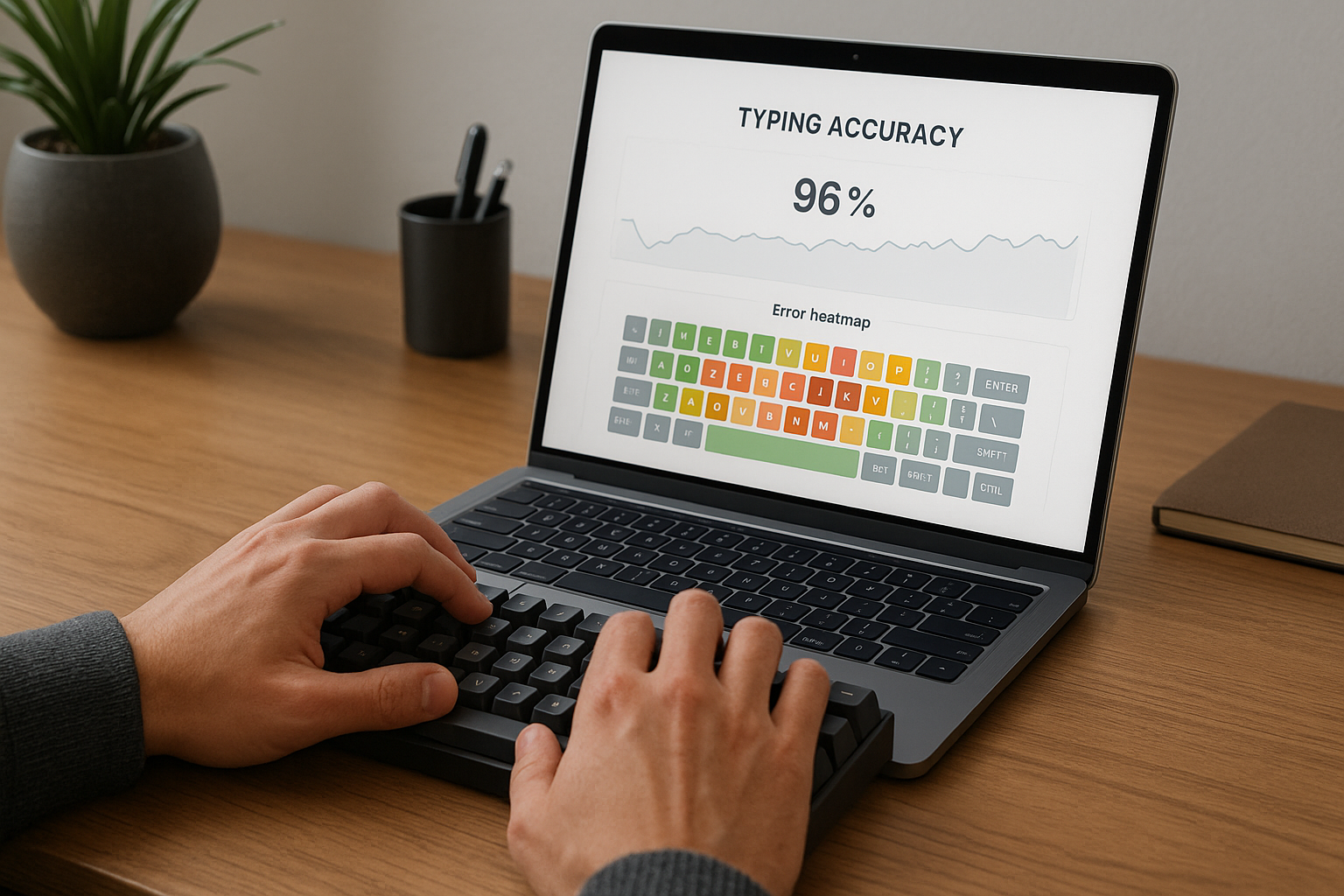
This article gives you a complete threshold system you can run today. You will set floor values, map error types, and decide when to push speed based on data. If you are still setting up your baseline, start with Type Speed Test Baseline Routine: Measure Real Progress Before You Train. If pace collapses late in the run, pair this guide with Timed Typing Test Pacing Strategy: How to Hold Speed Without Accuracy Collapse. If your current benchmark process is unclear, use How Fast Can I Type Test? Benchmarks That Predict Real Output.
# What a typing accuracy test should measure
Most tools report one accuracy percentage. That value is useful, but incomplete. A strong typing accuracy test should separate where errors happen and what kind of errors they are.
Track these layers:
- full run accuracy,
- segment accuracy (start, middle, finish),
- corrected versus uncorrected errors,
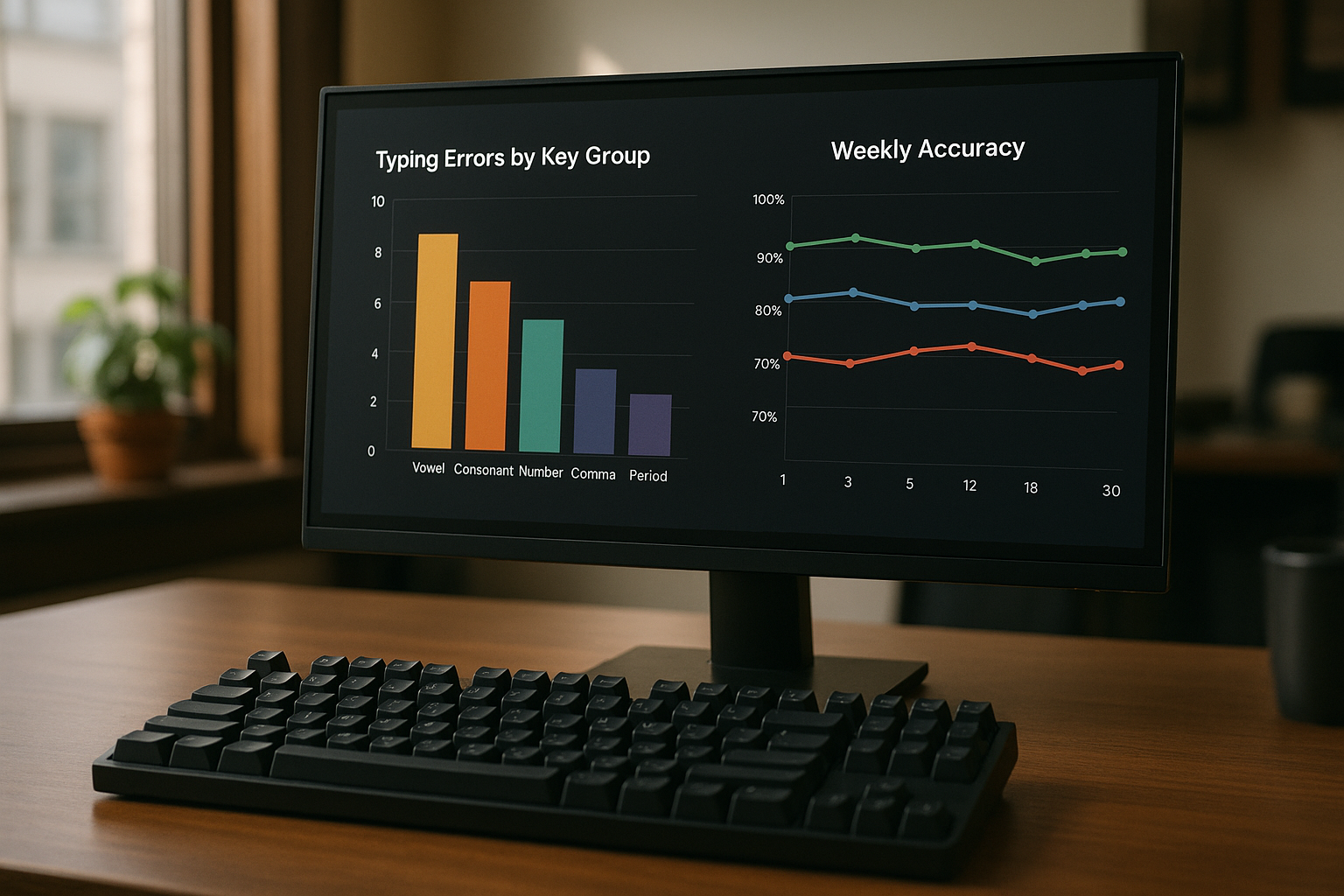
- error clusters by key group,
- recovery time after each error.
This structure matters because accuracy loss often concentrates in one run phase. Many typists score 97 percent overall while dropping below 94 percent in the final segment. That pattern predicts unstable real output even when the headline score looks fine.
Skill learning research supports this approach. Consistent feedback loops and clear error signals produce more durable motor improvement than occasional high effort attempts (NIH motor learning overview (opens new window)). Reliable training decisions also require repeated samples and robust summaries instead of single best runs (NIST Engineering Statistics Handbook (opens new window)).
# Typing accuracy test thresholds that map to real output
Set thresholds by level, then adjust only after seven sessions with stable results. For 60 second runs, use this table.
| Current median WPM | Accuracy floor | Segment floor (final 20s) | Max corrected errors per run | Promotion rule |
|---|---|---|---|---|
| 30 to 45 | 95.5% | 94.5% | 8 | Raise pace by 1 WPM after 7 stable sessions |
| 46 to 60 | 96.5% | 95.5% | 7 | Raise pace by 1 WPM after 7 stable sessions |
| 61 to 75 | 97.0% | 96.0% | 6 | Raise pace by 1 WPM after 7 stable sessions |
| 76 to 90 | 97.5% | 96.5% | 5 | Raise pace by 1 WPM after 8 stable sessions |
| 91+ | 98.0% | 97.0% | 4 | Raise pace by 1 WPM after 10 stable sessions |
These thresholds reduce the common trap where raw speed rises while correction time grows. If your platform does not expose corrected error counts, approximate with backspace events or replay logs.
# Direct test protocol you can run in 25 minutes
Run this protocol four to six days per week with fixed setup.
- Calibration block (4 minutes)
- Two short warmup runs at controlled pace.
- Log readiness only.
- Benchmark block (12 minutes)
- Four runs at 60 seconds.
- Rest 60 to 75 seconds between runs.
- Log run and segment accuracy.
- Accuracy stress block (7 minutes)
- Two punctuation heavy runs.
- One mixed symbol run.
- Review block (2 minutes)
- Write one decision for tomorrow.
Use the same keyboard, layout, and posture through each weekly cycle. Physical setup variance can change outcomes enough to hide skill trends. Ergonomics references from OSHA workstation guidance (opens new window) help keep that stable.
# Error taxonomy for typing accuracy test logs
A useful typing accuracy test log does more than count mistakes. It labels mistakes so your drills stay targeted.
Use five categories:
- Substitution: wrong key pressed, often neighbor key drift.
- Omission: skipped key, common during high cadence transitions.
- Insertion: extra key, often from premature next-key motion.
- Transposition: letter order swap in bigrams.
- Timing reset: hesitation after correction that breaks rhythm.
When one category exceeds 35 percent of your total errors for a week, that category becomes your primary drill target. This keeps intervention specific and prevents random drill hopping.
# Decision checklist: when to push speed and when to hold
Use this checklist at the end of each week.
- Accuracy floor met in at least 6 of last 7 sessions.
- Final segment floor met in at least 5 of last 7 sessions.
- Corrected error count stable or improving.
- Recovery time after errors stable.
- Transfer sample from real writing within 90 percent of benchmark speed.
If all five checks pass, raise target pace by 1 WPM. If one check fails, keep pace fixed and keep the same drill focus for one more week. If two or more checks fail, reduce target pace by 1 to 2 WPM and rebuild control.
# Worked example: typing accuracy test thresholds in practice
Starting profile:
- median benchmark: 58 WPM,
- full run accuracy: 96.2 percent,
- final segment accuracy: 94.8 percent,
- corrected errors: 8.3 average,
- primary error type: transposition.
Threshold plan selected:
- full run floor: 96.5 percent,
- final segment floor: 95.5 percent,
- corrected errors cap: 7,
- weekly promotion condition: 7 stable sessions.
Intervention for 10 days:
- launch pace reduced by 1 WPM,
- six minute bigram transposition drill each session,
- strict one-breath reset after every correction,
- no pace increase until all floors hold.
Outcome after 10 days:
- median benchmark: 60 WPM,
- full run accuracy: 97.0 percent,
- final segment accuracy: 96.1 percent,
- corrected errors: 6.4 average,
- transfer sample improvement: +3 WPM in normal writing.
The improvement came from fewer corrections and better finish control, not from opening sprints.
# How to adapt thresholds by test duration
A typing accuracy test at 15 seconds, 60 seconds, and 120 seconds measures different capacities. Use duration specific floors.
- 15 seconds: use 0.5 point higher accuracy floor than 60s.
- 60 seconds: use baseline floor from the table.
- 120 seconds: allow 0.5 point lower floor, but demand tighter finish stability.
Example for a 65 WPM typist:
- 15s floor: 97.5 percent,
- 60s floor: 97.0 percent,
- 120s floor: 96.5 percent plus finish floor of 95.8 percent.
This keeps long run fatigue from forcing unrealistic standards while still protecting transfer quality.
# Internal benchmark formulas that improve decision quality
Use two compact formulas in your log.
- Effective WPM
effective_wpm = raw_wpm × (accuracy / 100)
- Finish stability ratio
finish_stability = final_segment_wpm / middle_segment_wpm
For most users, finish stability below 0.94 predicts correction spirals in real writing. Keep pace changes frozen until this ratio improves.
If you compare week to week changes, use medians rather than averages. Medians reduce distortion from one bad run or one lucky run.
# Common typing accuracy test mistakes that stall progress
# Mistake 1: using one global accuracy goal
A single 97 percent goal ignores level differences and duration effects. Use threshold bands tied to your current speed.
# Mistake 2: promoting pace after one good day
One strong day is normal variance. Promotion should require repeated sessions.
# Mistake 3: ignoring corrected errors
Raw accuracy can stay high while corrected error count rises. That pattern hurts throughput.
# Mistake 4: changing keyboard settings mid-cycle
If you change debounce, switch profile, or keymap in the same week, attribution breaks. Keep one stable setup per cycle. For firmware details, use QMK documentation (opens new window).
# Mistake 5: training with only easy text
Easy lowercase passages inflate confidence and reduce transfer. Keep at least two realistic or punctuation heavy runs in each session.
# Recommended weekly template for typing accuracy test improvement
Run this template for two weeks before changing structure.
- Day 1: baseline plus category map.
- Day 2: substitution focused drill.
- Day 3: transposition focused drill.
- Day 4: punctuation and symbol stress.
- Day 5: transfer session with normal writing.
- Day 6: benchmark only, no experimental changes.
- Day 7: rest or light calibration.
This structure rotates stressors while keeping measurement clean. It also reduces repetitive training fatigue that can hide true progress.
# The practical rule for next month
Use typing accuracy test thresholds as your control system. Keep pace stable until floors hold across a full week. Promote speed in small increments, and only when segment accuracy and correction load both support it. This method builds usable WPM that survives outside test passages, which is the metric that matters for real writing and coding output.