

A WPM typing test score of 80 is realistic for many intermediate typists when training targets stability instead of peak bursts. The shortest path is a measured loop: set a baseline, train one bottleneck at a time, verify with timed runs, and only increase pace after accuracy and error recovery hold for several sessions. This guide gives you a four week structure you can run with TypeTest and adapt to your current level.

If you have not measured your baseline cleanly yet, start with Type Speed Test Baseline Routine: Measure Real Progress Before You Train. If your scores vary heavily by session length, pair this guide with Typing Test WPM: Normalize Scores Across Duration and Difficulty. If your finish collapses near the final 20 seconds, also review Timed Typing Test Pacing Strategy: How to Hold Speed Without Accuracy Collapse.
# What “80 WPM” should mean in practice
Many typists report a best run and call it their speed. That creates weak planning data. For training decisions, define 80 WPM with three conditions:
- Median score at or above 80 across at least six 60 second runs in a week.
- Accuracy floor of at least 96 percent on those runs.
- Transfer check above 0.90, where transfer check means your real writing WPM divided by your median test WPM.
This definition avoids a common trap where short bursts rise but real output remains flat.
For context on motor performance and reliable measurement, these references are useful:
- NIST Engineering Statistics Handbook (opens new window)
- NIH overview on motor learning principles (opens new window)
- OSHA workstation guidance for computer setup (opens new window)
# The metric stack that predicts progress to 80 WPM
Use a small set of metrics you can compute after every session.
- Median WPM for timed runs.
- Accuracy percent for timed runs.
- Corrected errors per 100 words.
- Recovery time after mistakes in seconds.
- Session variance as standard deviation of run WPM.
Derived metrics:
correction_density = corrected_errors / words_typed * 100
transfer_ratio = real_task_wpm / timed_median_wpm
stability_band = p75_wpm - p25_wpm
A stable progression usually looks like this: correction density falls first, then stability band narrows, then median WPM rises.
# 80 WPM readiness assessment
Use this decision table before starting a hard pace push.
| Current profile | Likely bottleneck | Main intervention | Pace policy |
|---|---|---|---|
| 62 to 68 WPM, accuracy below 95.5 | correction debt | slow control blocks and error category drills | hold pace for 7 sessions |
| 68 to 74 WPM, accuracy 96 to 97, high variance | rhythm instability | cadence intervals and fixed segment pacing | increase by 1 WPM only after 4 stable sessions |
| 74 to 78 WPM, strong start and weak finish | pacing distribution | three phase timed structure with conservative open | keep target until finish segment improves |
| 74 to 79 WPM, accuracy high but transfer low | poor real task carryover | mixed passage practice and daily transfer checks | keep pace, improve transfer before promotion |
| 79 plus occasional peaks, median below 80 | consistency gap | weekly consolidation and fatigue control | no pace increase until median clears 80 |
Most people in the 70s do not need more intensity. They need tighter control of pace spread and correction behavior.
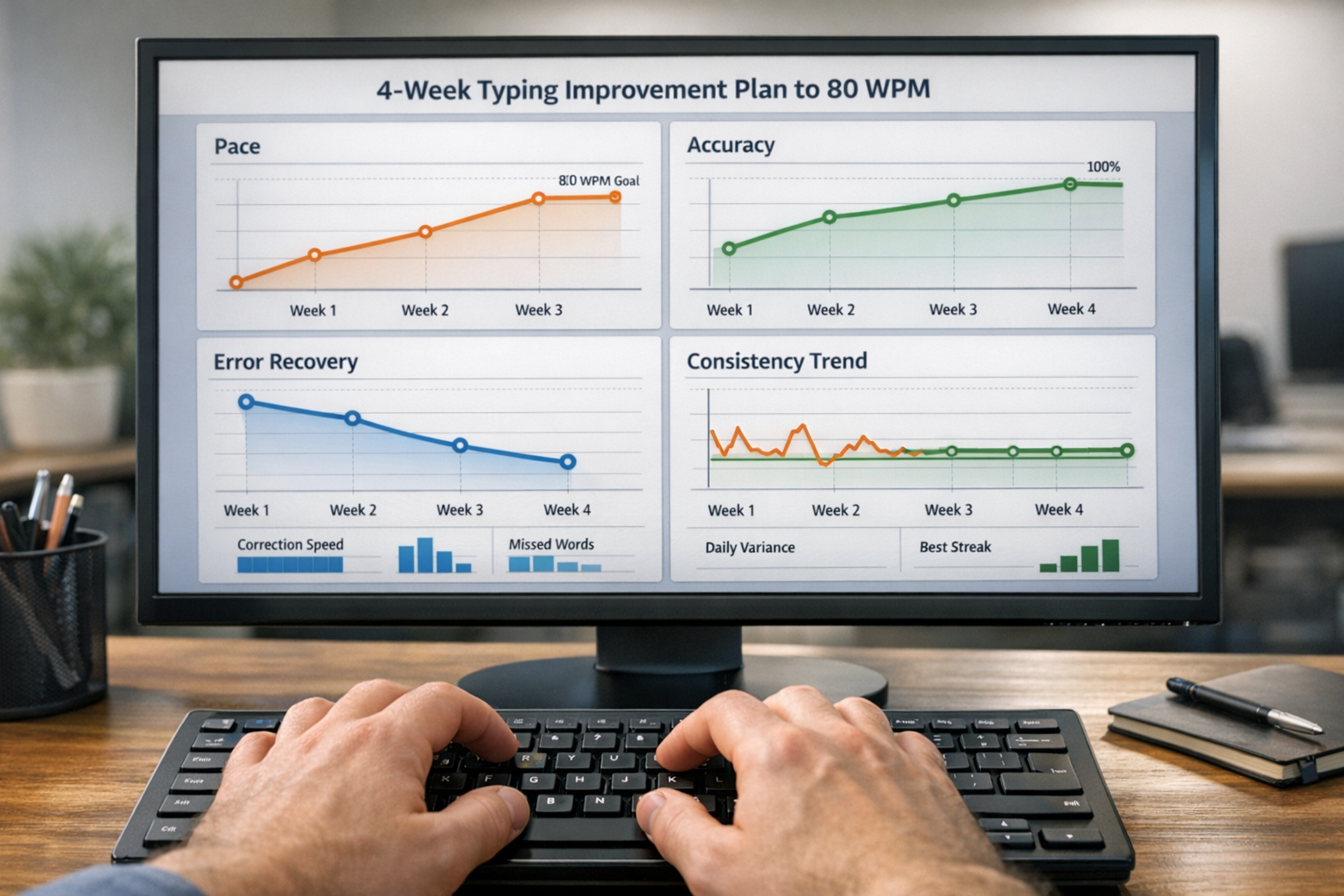
# Four week WPM typing test plan to reach stable 80
The plan uses six training days and one light day each week. Keep keyboard, layout, and test duration fixed across the block.
# Week 1: baseline tightening
Goal: reduce correction drag and map repeat error categories.
Session structure, 30 minutes:
- 5 minutes warmup with one easy and one mixed punctuation passage.
- 12 minutes no timer control work.
- 8 minutes category drills for your top error group.
- 5 minutes timed verification with two 60 second runs.
Promotion rule to Week 2 intensity:
- correction density down by at least 10 percent versus day 1
- timed accuracy at least 96 percent in four of six sessions
# Week 2: cadence and segment pacing
Goal: hold rhythm from start to finish in timed runs.
Run each 60 second test in three phases:
- 0 to 15 seconds at controlled entry pace
- 15 to 45 seconds at target pace
- 45 to 60 seconds at accuracy protection pace
Add one 90 second run every second day to expose late run breakdowns.
Promotion rule:
- finish segment WPM within 3 points of middle segment median
- session variance reduced compared with Week 1
# Week 3: controlled intensity
Goal: push median upward without losing floor metrics.
Add one higher pace run only after two stable runs in the same session. Keep no timer work, but shorten it. Preserve recovery tracking after each error.
Promotion rule:
- median timed WPM improves by at least 2 points versus Week 2
- accuracy still at least 96 percent
- transfer ratio at or above 0.88 and rising
# Week 4: consolidation at 80
Goal: make 80 repeatable, not occasional.
Use six sessions with this mix:
- 3 consistency sessions at target pace
- 2 load sessions with longer passages
- 1 verification session with full weekly summary
End of week pass criteria:
- median at or above 80
- accuracy at or above 96 percent
- stability band no wider than 6 WPM
- transfer ratio at or above 0.90
# Daily session template you can run in TypeTest
Use this operational checklist each day.
- Fixed setup: same keyboard, layout, chair height, and test duration.
- Warmup: two passages, one simple and one mixed punctuation.
- Control block: no timer run with correction focus.
- Drill block: one error category only.
- Timed block: two to four 60 second runs.
- Log block: capture metrics and one short note on failure mode.
A single category per day matters. Splitting focus across multiple problems reduces adaptation speed because your feedback loop gets noisy.
# How to choose the right drill by failure mode
Use this mapping when your runs stall.
# Substitution errors under pace
Pattern: wrong nearby key during acceleration.
Intervention:
- short bigram drills using affected key pairs
- two minute blocks with strict accuracy floor
- return to timed run only after two clean drill blocks
# Transposition clusters
Pattern: letter order flips in common trigrams.
Intervention:
- moderate pace phrase drills with explicit rhythm count
- metronome style cadence in short blocks
- finish with one conservative timed run
# Backspace chains
Pattern: one mistake becomes several corrections.
Intervention:
- recovery drills that resume on next word boundary
- cap backspace events per run
- pace reduction by 1 to 2 WPM for two sessions
# Late run collapse
Pattern: strong first half, steep drop in final segment.
Intervention:
- phase pacing with slower open
- one longer run every other day
- focus on finish accuracy, then re lift pace
# A practical example from 72 to stable 80
Starting week profile:
- median 60 second WPM: 72
- accuracy: 96.4 percent
- correction density: 4.9 per 100 words
- transfer ratio: 0.84
- strongest failure mode: late run collapse
Intervention highlights:
- week 1 correction density work with no timer focus
- week 2 phase pacing in every timed run
- week 3 selective high pace attempts only after clean entries
- week 4 consolidation with strict fatigue control
Week 4 result:
- median 60 second WPM: 80.6
- accuracy: 96.8 percent
- correction density: 3.6 per 100 words
- transfer ratio: 0.91
- stability band: 5.2 WPM
The key change was not maximum effort. It was reducing correction cost and holding rhythm in the last segment.
# Hardware and environment controls that protect progress
Skill gains can disappear in noisy setups. Keep these controls stable during your 80 WPM block.
- Use one keyboard only for the full four weeks.
- Keep repeat and delay settings unchanged.
- Keep desk and chair geometry fixed.
- Train in similar daily time windows.
- Track sleep and fatigue with a simple 1 to 5 score.
If you tune keyboard firmware or debounce settings, annotate the change date in your logs and treat the next two sessions as a new baseline window. For implementation references, see QMK documentation (opens new window) and keyboard latency method notes from RTINGS (opens new window).
# When to increase pace and when to hold
Increase target pace by 1 WPM only when all conditions hold for at least four sessions:
- median WPM above current target
- accuracy at or above floor
- correction density stable or improving
- no finish segment collapse
Hold pace when one condition fails.
Reduce pace by 1 WPM for two sessions when two or more fail. This reset often restores control faster than forcing unstable runs.
# Final operating rule
Treat your WPM typing test like a controlled training system. Build reliability first, then raise pace in small steps with hard pass criteria. If your logs show stable median, stable accuracy, and rising transfer ratio, 80 WPM becomes a repeatable operating speed instead of an occasional peak.