

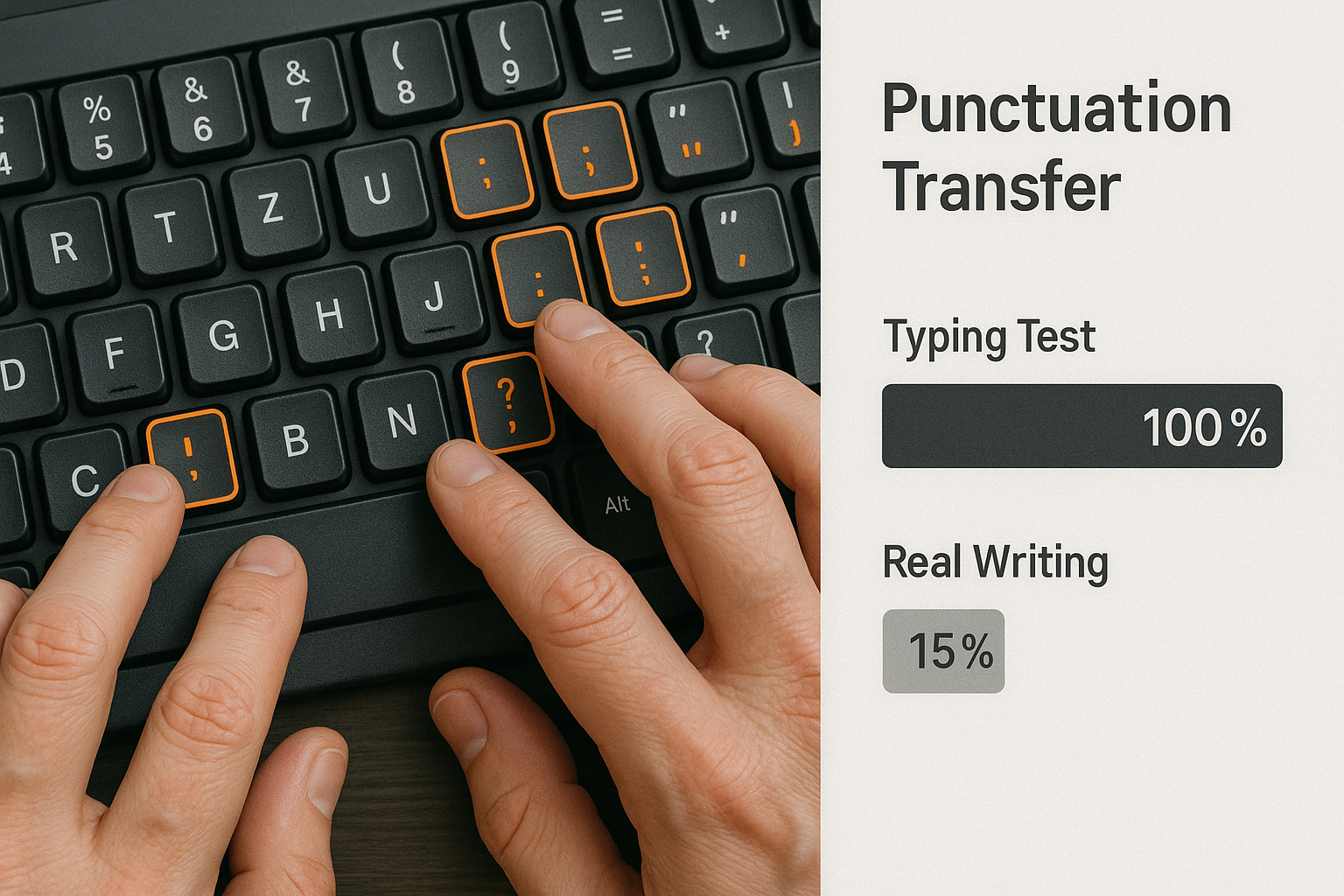
A typing test lowercase only mode can help you build rhythm fast, especially if punctuation errors keep breaking your flow. It also inflates scores if you treat it as your final benchmark. The practical approach is to use lowercase runs for capacity, punctuation runs for transfer, and a weekly conversion check that ties both to real writing output.

If you want to turn this into daily training, pair this guide with Type Speed Test Baseline Routine: Measure Real Progress Before You Train, Typing Test No Timer Method: Build Speed That Transfers to Real Work, and Type Speed Test Calibration: Convert No Punctuation Scores Into Real Writing Speed.
# What lowercase only mode measures well
Lowercase only mode is strong at measuring continuous letter production. You remove punctuation reach, reduce symbol decisions, and spend more time in repeatable finger patterns.
That gives you clean signal in three areas:
- Rhythm stability across 30 to 90 second runs.
- Error recovery on common letter patterns.
- Baseline pace without symbol switching overhead.
For newer typists, this can reduce frustration enough to keep practice consistent. For intermediate typists, it can expose whether the ceiling is finger speed or correction behavior.
The useful framing is simple. Lowercase only mode measures capacity speed. Real writing needs production speed.
# Why lowercase only scores often overstate real output
Real writing includes commas, periods, apostrophes, capitalization, numbers, and edits. Each of those adds decision and movement cost.
From a motor learning perspective, complexity raises coordination demand and affects speed accuracy balance over repeated trials. This is consistent with broader skill acquisition findings in NIH indexed reviews of motor learning and performance variability (NIH (opens new window)).
From an input perspective, punctuation and symbols depend on keyboard event handling and shifted key patterns that are structurally different from lowercase letter streams (W3C UI Events Key Values (opens new window)).
From a workstation perspective, posture and setup quality affect sustained control and fatigue, which matters more as text complexity rises (OSHA computer workstation guidance (opens new window)).
In plain terms, lowercase mode removes enough friction that your score is usually higher than what you can sustain in normal writing.
# Decision table: should lowercase only be your main mode right now
| Current pattern | What it means | Best primary mode this week | Secondary mode |
|---|---|---|---|
| Accuracy below 94 percent in timed tests | Control is the bottleneck | Lowercase only for control blocks | Short punctuation verification |
| Accuracy 95 to 97 percent but pace collapses late | Pacing and fatigue are bottlenecks | Mixed mode with fixed segment pacing | Lowercase warmup block |
| Strong lowercase score but weak transfer to writing tasks | Symbol and correction overhead are bottlenecks | Punctuation and mixed text blocks | Lowercase speed maintenance |
| Daily score volatility above 8 WPM | Protocol inconsistency or fatigue noise | Lowercase baseline protocol | One weekly mixed calibration |
| Stable transfer ratio above 0.90 | Good cross mode transfer already | Mixed real text training | Lowercase only as occasional reset |
Use lowercase only as a tool, not as identity. Your goal is reliable output in real tasks.
# The transfer metric that keeps scores honest
Track one metric each week:
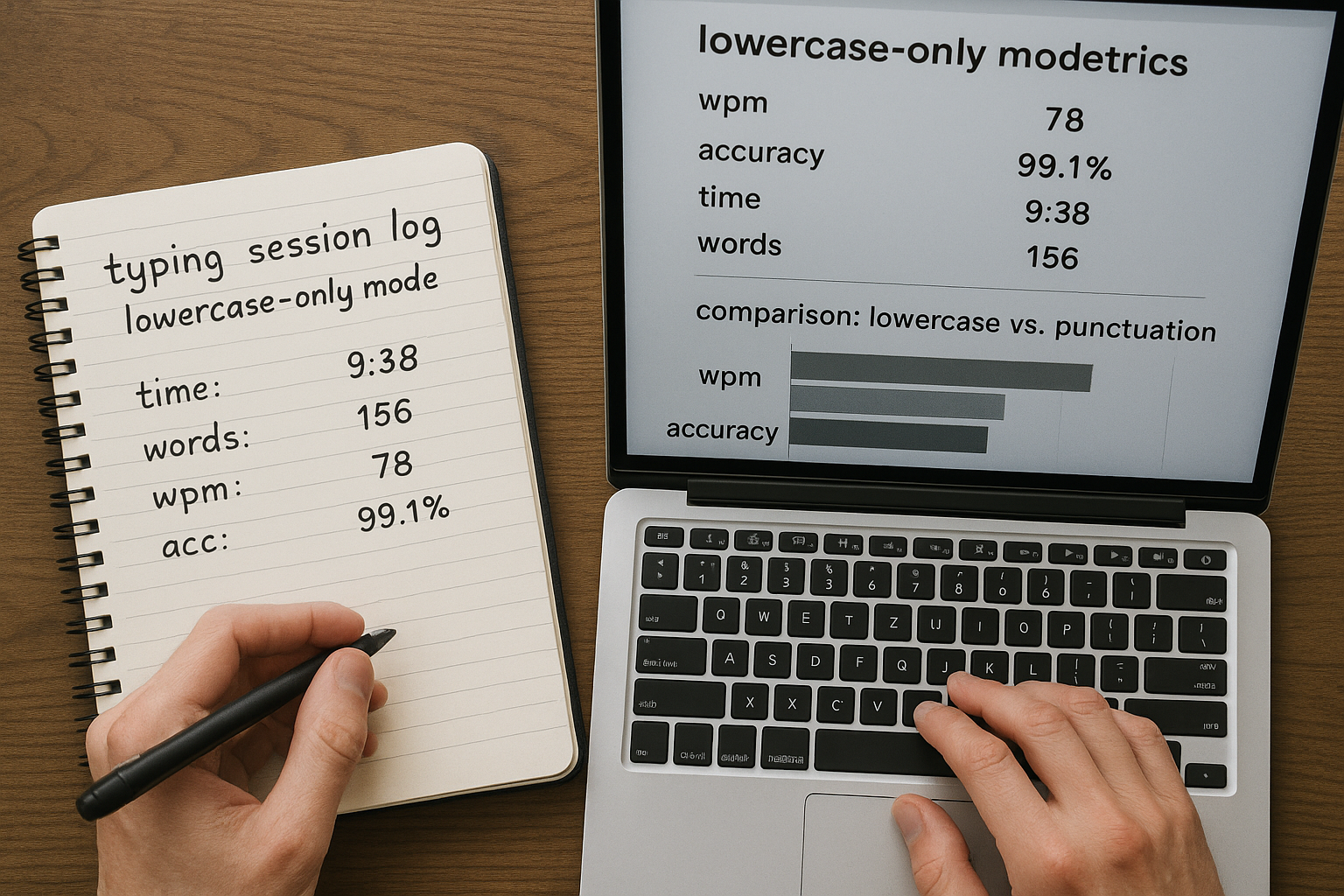
transfer_ratio = real_task_wpm / lowercase_only_median_wpm
Example:
- Lowercase only median: 82 WPM
- Real writing block: 68 WPM
- Transfer ratio: 0.83
If your lowercase score goes up but transfer ratio falls, your practice is drifting away from practical output. That is a signal to reduce lowercase volume and increase mixed mode runs.
# A 14 day training split that uses lowercase mode correctly
This structure keeps lower friction practice while protecting transfer.
# Days 1 to 4: establish stable baseline
- 2 warmup runs, 30 seconds each.
- 6 lowercase only runs, 60 seconds each.
- 2 punctuation runs, 60 seconds each.
- 1 real writing block, 8 to 10 minutes.
Log median WPM, accuracy, corrected error count, and transfer ratio.
# Days 5 to 9: preserve speed, increase complexity exposure
- 3 lowercase only runs, 60 seconds.
- 4 punctuation runs, 60 seconds.
- 2 mixed length runs, 120 seconds.
- 1 targeted correction drill on your top error cluster.
Goal is to keep lowercase pace stable while narrowing the gap between simplified and realistic text.
# Days 10 to 14: transition to production focus
- 2 lowercase only runs as warmup.
- 5 punctuation or mixed runs.
- 1 no timer control run for accuracy reset.
- 1 real writing block with your usual work style.
At the end of day 14, compare median values from days 1 to 4 and days 10 to 14.
Keep the split only if both are true:
- Transfer ratio improved by at least 0.03.
- Accuracy stayed stable or improved.
# How to avoid the common lowercase only trap
The trap is training what is easy to measure instead of what you need to ship.
Use this checklist each week.
- Did I run at least two punctuation or mixed sessions for every three lowercase sessions?
- Did I run at least one real writing transfer block?
- Did I log medians instead of only personal best runs?
- Did I keep keyboard layout and settings unchanged during the measurement week?
- Did I keep test duration consistent for comparisons?
- Did I inspect correction behavior, not only WPM?
If two or more answers are no, your score trend is likely less reliable than it looks.
# Lowercase only and confidence: useful, but with boundaries
Lowercase mode is often useful for confidence recovery after a bad week. It gives cleaner feedback loops and faster visible improvement. That is legitimate.
Boundary condition is straightforward. Confidence work should be time boxed.
A practical cap for most typists:
- Up to 40 percent of weekly volume in lowercase only blocks.
- At least 60 percent in punctuation or mixed text blocks.
If your goal is coding comments, emails, reports, or school writing, this split keeps motivation without losing transfer.
# What to do when lowercase improves but real writing does not
If this happens for two weeks, use a bottleneck diagnosis pass.
- Check correction density.
- Check late segment pace drop.
- Check posture and fatigue timing.
- Check whether punctuation keys are concentrated in a few frequent misses.
Then apply one intervention only.
- High correction density: accuracy first pacing ladder for 1 week.
- Large late drop: shorter intervals with controlled pace ceiling.
- Symbol specific misses: micro drills with common punctuation bigrams.
- Setup fatigue: workstation adjustment and shorter dense blocks.
Change one variable at a time. Multi change weeks create noisy data.
# Example weekly plan for a 70 WPM typist targeting practical 80
Starting point:
- Lowercase median: 78 WPM
- Mixed text median: 66 WPM
- Real writing WPM: 64
- Transfer ratio from lowercase: 0.82
Four week target:
- Lowercase median: 82 to 84
- Mixed text median: 72 to 74
- Real writing WPM: 70 to 72
- Transfer ratio from lowercase: 0.86 to 0.88
Weekly schedule:
- Monday: lowercase control plus punctuation verification.
- Tuesday: punctuation density drills.
- Wednesday: mixed 120 second pacing work.
- Thursday: lowercase maintenance and error cleanup.
- Friday: transfer block in real writing task.
- Weekend: one light review session or rest.
This structure makes lowercase mode a contributor to production, not a separate game.
# How TypeTest users can apply this with minimal friction
Set two saved routines.
Routine A, lowercase capacity:
- Same duration daily.
- Same warmup pattern.
- Used for rhythm and confidence.
Routine B, production transfer:
- Punctuation enabled.
- Includes one longer run.
- Includes a weekly real text block.
Review once per week with three numbers:
- Lowercase median WPM.
- Production median WPM.
- Transfer ratio.
If lowercase rises while transfer stalls, shift volume from A to B next week.
If both rise together, keep the split unchanged.
# FAQ
# Is lowercase only mode good for beginners
Yes. It lowers complexity and makes early repetition easier to sustain. Keep one or two short production runs each session so transition cost does not build up.
# How often should I run punctuation tests
At least three times per week if your goal is real writing speed. Daily is better when transfer ratio is below 0.85.
# Should I compare myself with other users in lowercase mode
Use it carefully. Lowercase only leaderboards can motivate practice, but they do not represent full writing throughput. Track your own transfer ratio first, then compare trends.
# What if my lowercase score drops after adding mixed text work
Short term drops are common during adaptation. Keep protocol stable for at least 10 to 14 days before changing plan, then evaluate median and transfer trend together.
# Final takeaway
Typing test lowercase only mode is effective for building pace and reducing early frustration. It becomes misleading when used as the only benchmark. Use it as a capacity tool, pair it with production runs, and decide with transfer ratio. That turns faster test scores into faster writing you can actually use.