

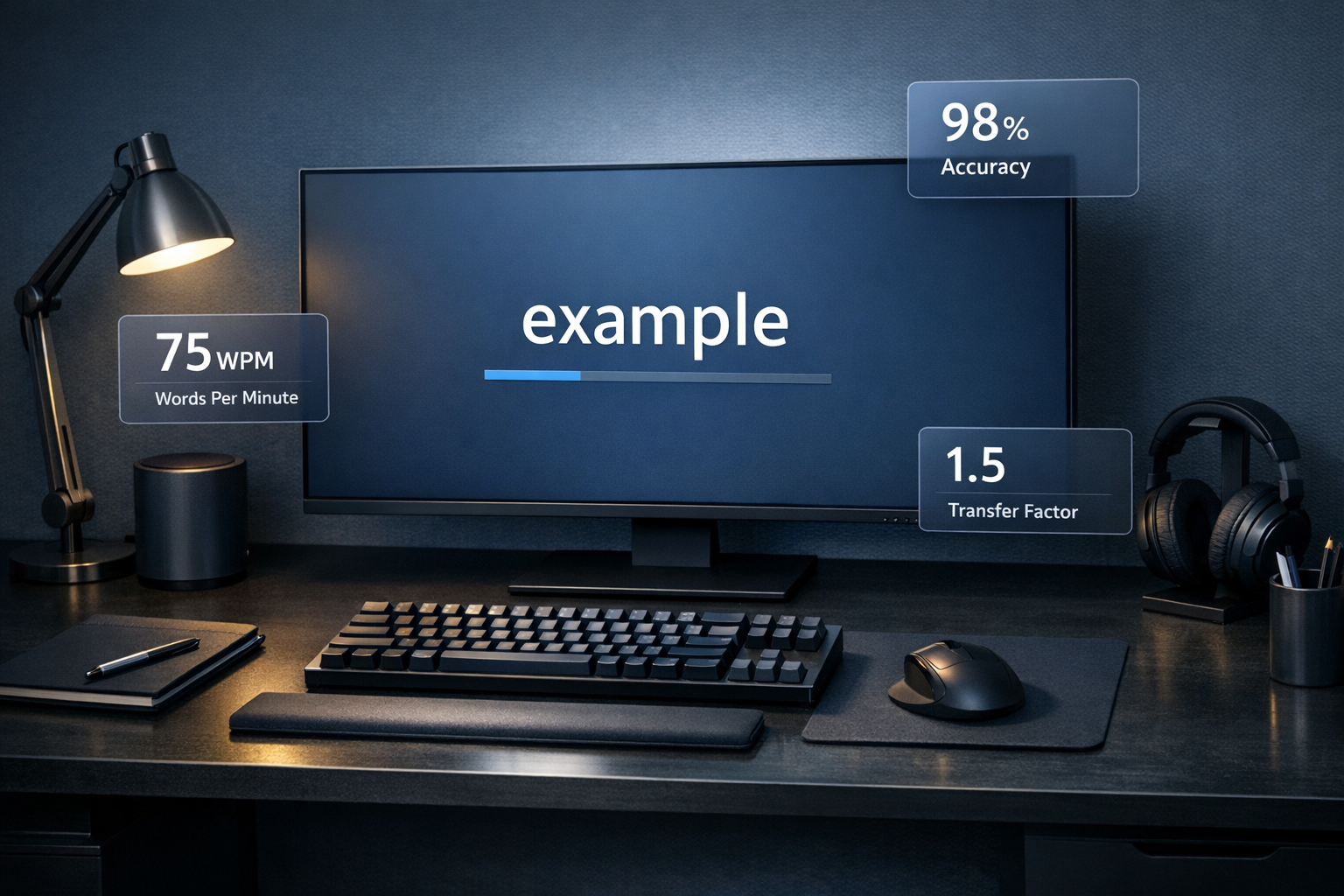
A one word WPM test can reveal your raw key-to-key speed, but by itself it often overstates what you can sustain in real writing. Single-word prompts reduce punctuation load, lower context switching, and shorten correction chains. That makes them useful for measuring peak rhythm, not full-task throughput.
If you already use timed sessions, pair this guide with Timed Typing Test Lap Method: Convert Sprint Speed Into Stable 60-Second WPM, Typing Test No Timer Method: Build Speed That Transfers to Real Work, and Typing Test WPM: Normalize Scores Across Duration and Difficulty.
# What a one word WPM test measures well
Single-word tests are good at isolating movement efficiency:
- finger travel and return timing,
- burst cadence,
- short recovery after obvious mistakes,
- confidence on familiar letter patterns.
That makes this format valuable for baseline checks and warmups. It becomes misleading when you treat that score as your daily writing speed.
# Why one-word scores can look inflated
In normal writing, you handle capitalization, punctuation, and longer error-repair sequences. A one-word flow removes part of that workload.
The gap usually comes from three effects:
- Lower symbol complexity: fewer punctuation decisions per minute.
- Lower context memory load: short prompts require less lookahead.
- Cheaper corrections: mistakes are often fixed before they cascade.
So the practical question is not whether one-word tests are valid. The question is how to convert them into a stable estimate you can train against.
# Conversion model: from burst WPM to realistic WPM
Use this simple model:
realistic_wpm = one_word_wpm × transfer_factor
For most typists, a starting transfer factor between 0.82 and 0.92 works better than assuming 1:1 carryover.
You can estimate your own factor with a short protocol:
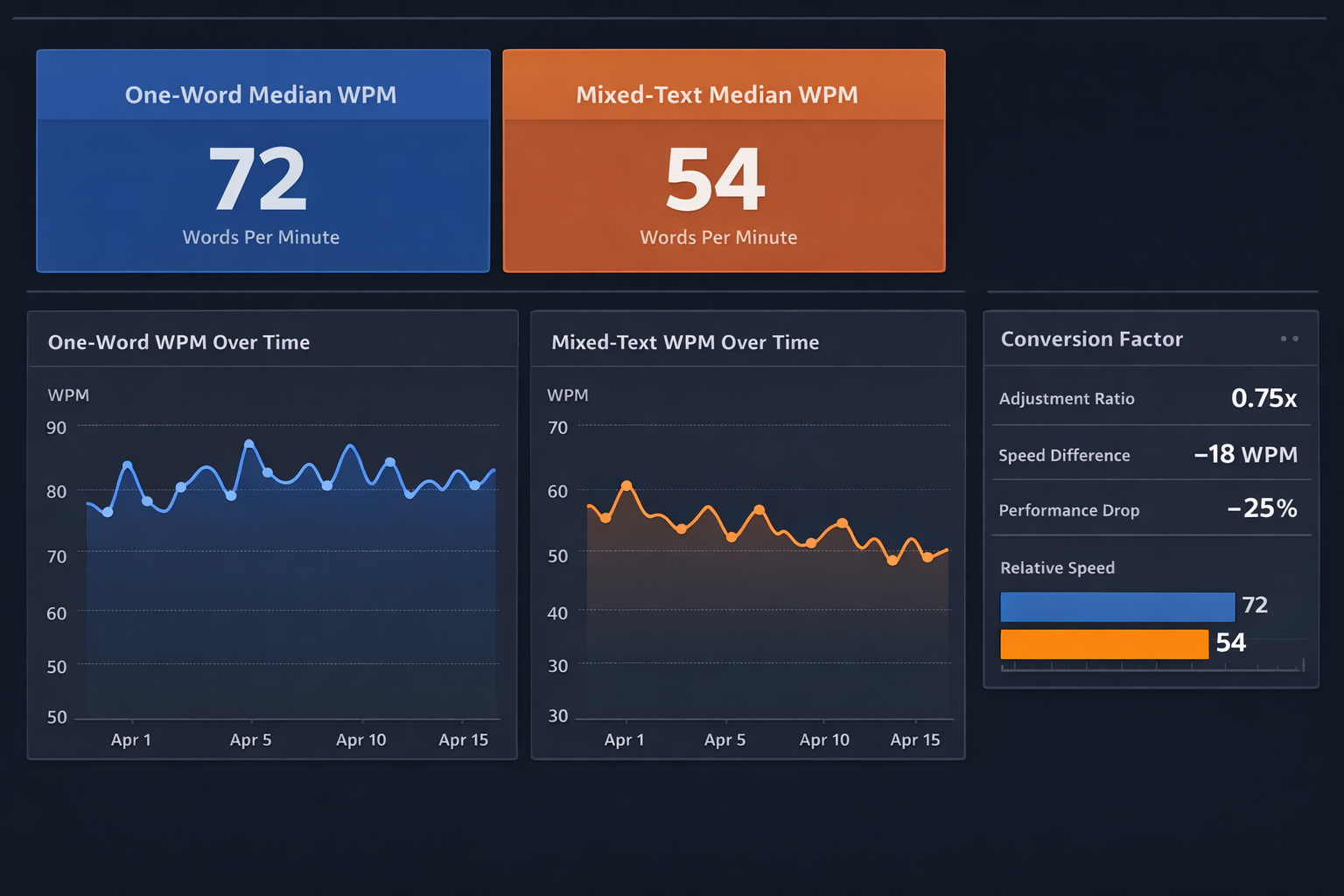
- Run 6 one-word tests (60 seconds each).
- Run 6 mixed-text tests (same duration, punctuation enabled).
- Use median effective WPM for each set.
- Compute
factor = mixed_text_median / one_word_median.
Example:
- one-word median: 88 WPM
- mixed-text median: 77 WPM
- transfer factor: 0.875
Converted estimate:
88 × 0.875 = 77 WPM
That becomes a stronger planning number than your burst peak.
# Decision table for training actions
| Pattern | Likely bottleneck | Adjustment | Recheck |
|---|---|---|---|
| High one-word score, low mixed-text score | punctuation and transition drag | add punctuation-enabled intervals twice weekly | 1 week |
| Similar one-word and mixed-text scores | good transfer control | increase pace target by 1 to 2 WPM | 1 week |
| Large day-to-day swings in one-word test | warmup inconsistency | standardize 3-minute warmup before tests | 4 sessions |
| Strong starts, weak finishes | pacing overshoot | cap first 10 seconds below peak pace | 3 sessions |
| Accuracy drop at higher pace | correction debt | set accuracy floor and back off pace | 5 sessions |
Use one change at a time so you can attribute results.
# Weekly protocol for reliable one-word WPM progress
# Step 1: keep conditions stable
Keep keyboard, layout, and repeat settings unchanged for the week. Sudden settings changes can mask skill movement, especially during short burst formats (Apple keyboard settings (opens new window), Windows keyboard behavior settings (opens new window)).
# Step 2: separate measurement and training
- Measurement days: one-word and mixed-text medians.
- Training days: drills targeted to your bottleneck.
This keeps your transfer factor trustworthy.
# Step 3: track effective WPM, not only raw WPM
If your platform exposes accuracy, calculate effective output:
effective_wpm = wpm × (accuracy / 100)
This penalizes unstable speed spikes and rewards usable performance.
# Step 4: verify transfer every 7 days
At the end of each week, rerun both test formats and compare medians. If one-word speed rises but mixed-text does not, shift volume toward punctuation and longer runs.
# Common mistakes with one-word typing tests
# Mistake 1: using one-word PRs as your only benchmark
Personal bests are motivating, but planning should use medians.
# Mistake 2: skipping punctuation exposure
Without punctuation sessions, conversion quality usually stalls.
# Mistake 3: changing hardware and settings too often
Frequent setup changes reduce comparability across sessions (MDN KeyboardEvent reference (opens new window)).
# Mistake 4: chasing pace while accuracy collapses
When error cost rises, your real throughput drops even if raw WPM looks higher.
# Practical target-setting using one-word data
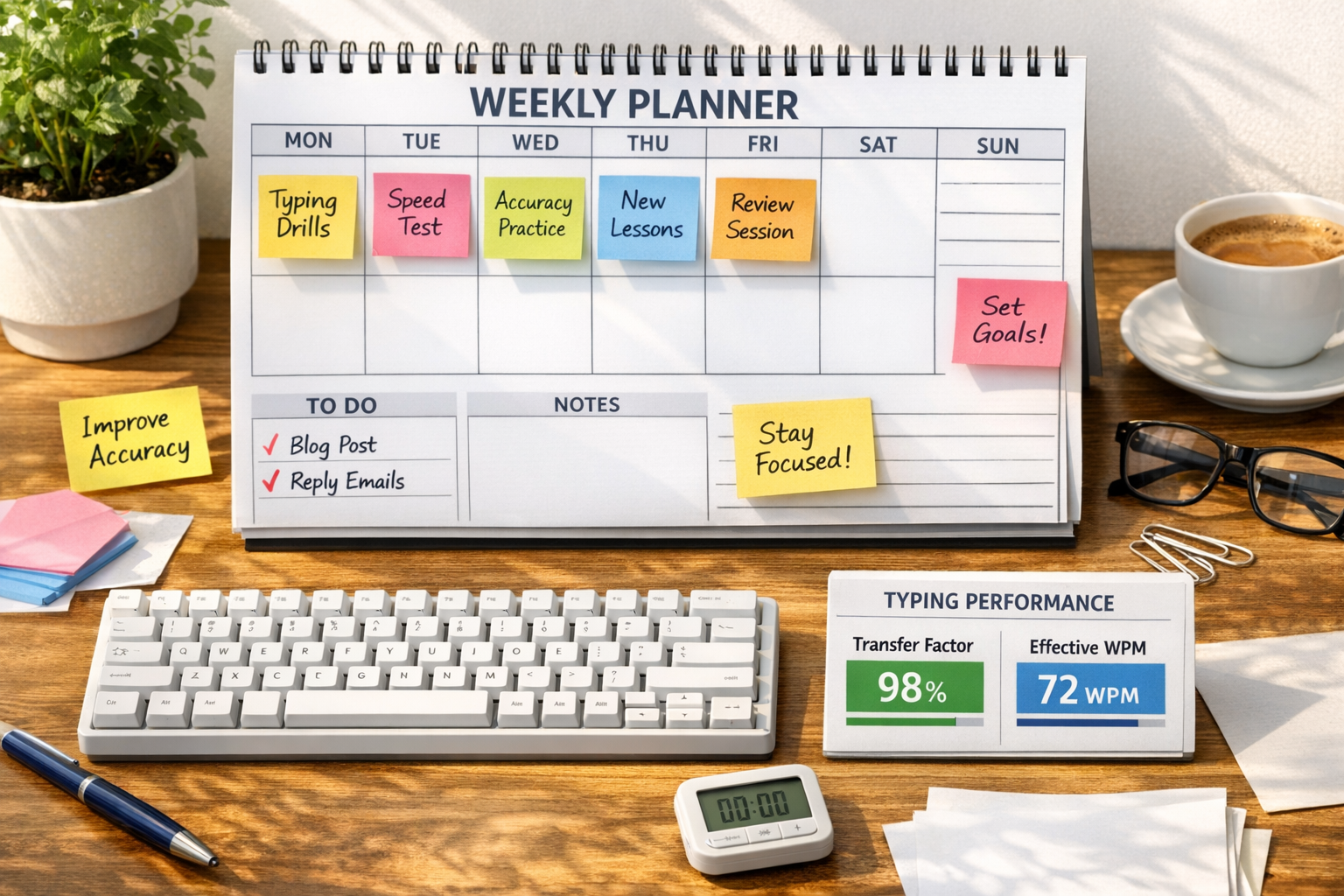
Use this quick framework each Monday:
- Record one-word median and mixed-text median.
- Update transfer factor.
- Set one weekly objective (pace, accuracy, or consistency).
- Define a pass condition (for example: mixed-text median +2 WPM at same accuracy floor).
This makes one-word tests actionable instead of vanity metrics.
# Final takeaway
A one word WPM test is excellent for measuring burst rhythm and short-cycle keying speed. Treat it as an input, not a final verdict. Convert one-word results with a personal transfer factor, track median effective output, and validate against mixed-text runs weekly. That workflow turns fast-looking scores into typing performance you can actually use.