

# Typing Test Indonesia: Measure WPM Fairly
A typing test Indonesia routine should measure how fast you can produce clean Indonesian text, not how well an English WPM score happens to translate. Use Indonesian passages, keep English scores separate, track accuracy, and log correction time. That gives you a fair baseline for school, office work, chat, and writing in Bahasa Indonesia.
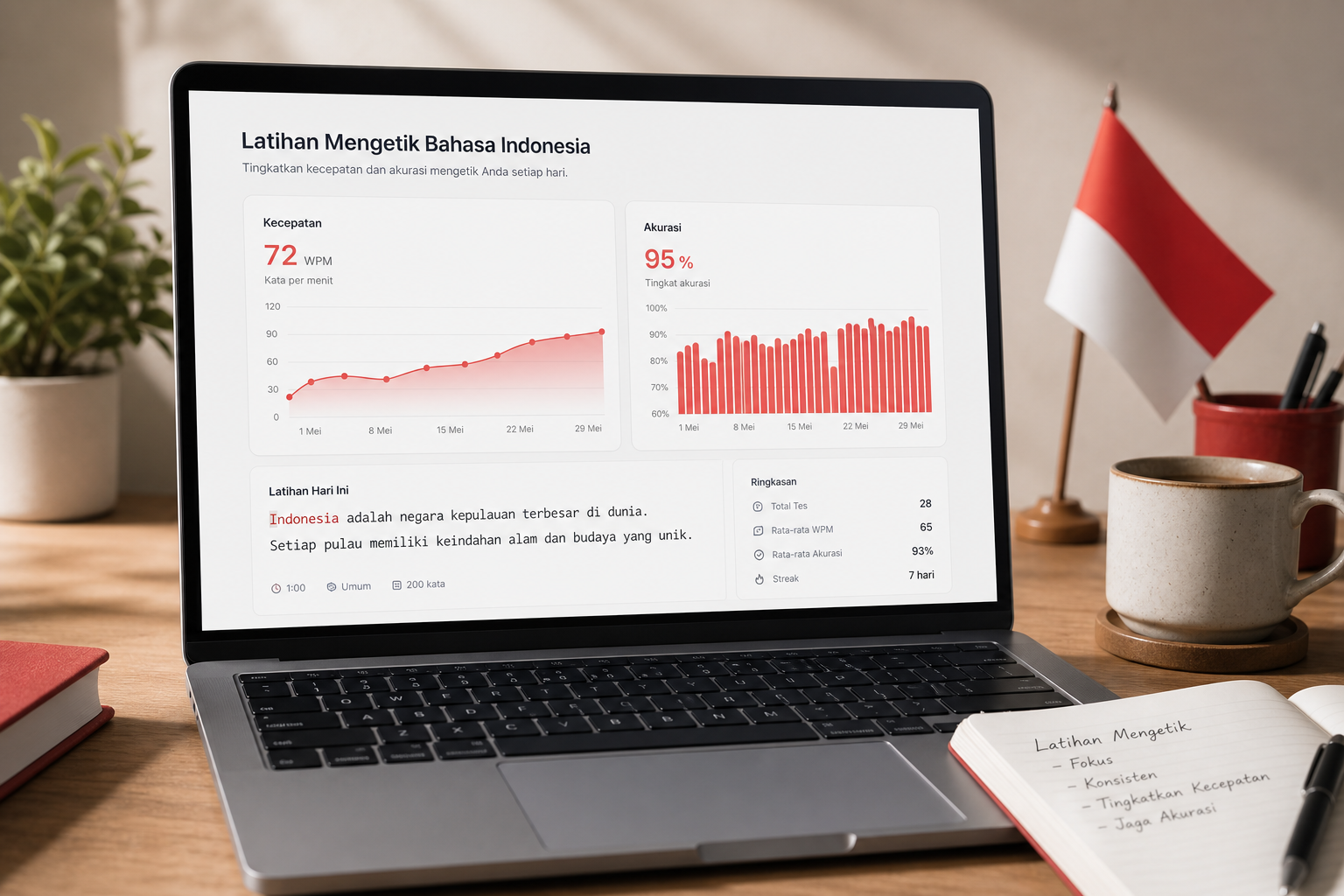
If you already use TypeTest for regular speed checks, keep your main baseline in the TypeTest typing test (opens new window) and compare Indonesian practice as its own track. For broader score context, use the passage advice in typing speed test passage difficulty, the setup controls in type speed test keyboard setup, and the warmup pattern in typing warm up.
# What a typing test Indonesia score should measure
A fair Indonesian typing score measures three things at once.
- WPM on Indonesian text, counted consistently across each run.
- Accuracy, including missed spaces, wrong letters, punctuation mistakes, and uncorrected typos.
- Correction cost, which is the time you lose when you backspace, retype, or pause to check a word.
The key is separation. English WPM and Indonesian WPM can both be useful, but they answer different questions. English passages often contain different word lengths, punctuation patterns, names, loanwords, and phrase rhythms. Indonesian text has its own common affixes, repeated syllable patterns, and spacing habits. One score should not pretend to explain both.
A 70 WPM English score and a 58 WPM Indonesian score might show a real language gap. It might also show that the Indonesian passage used more formal wording, longer named entities, or stricter punctuation. Without passage control, the number mostly flatters your spreadsheet.
For spelling and punctuation rules, use official Indonesian references when you build practice text. The Ejaan Bahasa Indonesia guide from Badan Pengembangan dan Pembinaan Bahasa (opens new window) is useful for punctuation, capitalization, and formatting rules. The KBBI dictionary (opens new window) helps when you want to check whether a word choice or spelling is standard.
# Run a fair Indonesian WPM baseline
Use this 18 minute protocol when you want a clean baseline rather than a lucky run.
- Warm up for 3 minutes with an easy Indonesian paragraph.
- Run three 2 minute Indonesian tests.
- Rest for 60 seconds between runs.
- Record WPM, accuracy, corrected errors, and uncorrected errors.
- Repeat the same structure with one English passage only if you want a comparison.
- Save the median Indonesian WPM as your baseline.
The median matters because one run can swing too much. A single hard sentence, notification, or typo spiral can distort the result. Three runs give you enough signal without turning a short check into a tiny research grant.
Use a passage of 120 to 220 words for each 2 minute run. That range gives enough room for faster typists while keeping the text short enough to review afterward. If the passage is too short, fast typists run into repetition. If it is too long, beginners may feel buried before the test starts.
Keep these settings stable.
| Setting | Use this choice | Why it matters |
|---|---|---|
| Test length | 2 minutes | Long enough to catch rhythm and correction cost |
| Passage type | Indonesian prose | Matches the skill you want to measure |
| Autocorrect | Off for desktop tests | Prevents software from hiding typing errors |
| Backspace | Allowed, but logged | Real writing includes correction, but correction has a cost |
| Score | Median of 3 runs | Reduces one-off noise |
| Retest timing | Same time of day when possible | Fatigue changes speed more than people like admitting |
If you type mostly on a phone, run a separate mobile baseline. Do not combine phone and keyboard scores. Thumb typing has different constraints, and a desktop comparison will blame the wrong thing.
# Build Indonesian practice passages that are actually useful
A good Indonesian typing passage should resemble the text you need to write. For most people, that means a mix of messages, study notes, work updates, and short explanatory paragraphs.
Use four passage bands.
| Band | Example content | Best for |
|---|---|---|
| Daily messages | Chat style sentences with short words | Rhythm, spacing, quick correction |
| School or office notes | Clean paragraphs with commas and formal terms | Practical writing speed |
| Data and names | Dates, places, names, amounts, abbreviations | Administrative work and reporting |
| Mixed language | Indonesian with a few English terms | Real workplace and study contexts |
Do not use only easy chat text. It will inflate speed and hide the places where errors appear. Do not use only formal text either. It can make practice feel like a punishment designed by a committee with a clipboard.
A balanced weekly set might include two easy passages, two formal passages, one passage with numbers, and one mixed language passage. Keep each passage in a note file so you can reuse it after two weeks. Immediate repeats measure memory more than typing.
Use official sources for language details, but write practice passages in your own words. The Unicode CLDR project (opens new window) is a useful reference for locale data and language support, while W3C guidance on declaring language in HTML (opens new window) explains why language tagging matters in web text. You do not need to know locale engineering to type better. You do need to respect that Indonesian text is its own target.
# Read the result without comparing the wrong things
After each session, sort the result into one of these patterns.
| Pattern | Likely cause | Next action |
|---|---|---|
| High WPM, low accuracy | You are outrunning word recognition | Slow by 5 WPM for one week and cap uncorrected errors |
| Medium WPM, high correction count | You recover well but start too loose | Practice first-pass accuracy with shorter runs |
| Low WPM, high accuracy | You are reading carefully but not chunking phrases | Use repeated phrase drills and 2 minute runs |
| Big English gap | Language-specific passage rhythm is the bottleneck | Train Indonesian passages separately for 10 days |
| Big number or name gap | Symbol and uppercase handling is weak | Add dates, names, and abbreviations twice a week |
The goal is not to force Indonesian WPM to match English WPM. The goal is to make the Indonesian score stable, explainable, and useful. A smaller but cleaner Indonesian score often transfers better to real work than a fast score built on easy words and ignored mistakes.
Track the median, not the best run. The best run is a morale snack. The median is the meal.
# A 10 day Indonesian typing practice plan
Use this plan when your Indonesian score feels lower than it should, but you cannot tell why.
Day 1: Baseline. Run the 18 minute test. Save the median WPM and accuracy.
Day 2: Easy rhythm. Type three short daily-message passages. Focus on steady spacing and fewer backspaces.
Day 3: Formal paragraph. Use one school or office style passage. Mark every punctuation mistake after the run.
Day 4: Names and numbers. Type dates, locations, amounts, and common abbreviations. Keep accuracy above speed.
Day 5: Rest or light warmup. Run only a 3 minute easy passage. Stop before fatigue changes the result.
Day 6: Mixed language. Use Indonesian sentences with common English product, school, or work terms.
Day 7: Correction control. Run two 2 minute tests where you only correct errors that would change meaning.
Day 8: Accuracy cap. Pick a target, such as 97 percent accuracy, and slow down until you hold it.
Day 9: Full passage set. Type one passage from each band. Compare error types, not only WPM.
Day 10: Retest. Repeat the Day 1 baseline with new Indonesian text at the same difficulty.
This plan gives you a practical artifact: a repeatable Indonesian passage set and a scorecard. Keep both. Rebuilding the test from scratch every time makes your data look busy while teaching you less.
# Common mistakes in a typing test Indonesia routine
The first mistake is mixing languages inside one score. Mixed language passages are useful, but label them clearly. A pure Indonesian baseline and a mixed language baseline should sit in different rows.
The second mistake is using copied text with odd formatting. Web pages can include invisible characters, curly quotes, nonbreaking spaces, or strange line breaks. Paste the passage into a plain text note first. Clean it before the test.
The third mistake is ignoring punctuation. Indonesian office writing often uses commas, abbreviations, dates, and names. A no punctuation test can help rhythm, but it should not become your only measure.
The fourth mistake is changing the keyboard setup while measuring progress. If you switch layouts, turn autocorrect on, change key repeat, or move from laptop keyboard to external board, log it. Better yet, hold the setup steady for 10 days.
The fifth mistake is treating every lower score as failure. A harder Indonesian passage can produce a lower WPM and still show better real skill. Accuracy and correction cost decide whether the speed is useful.
# Typing test Indonesia checklist
Before you trust a score, check this list.
- The passage is mostly Indonesian.
- The passage length fits the test duration.
- English and Indonesian scores are logged separately.
- Autocorrect and predictive text settings are written down.
- The keyboard, device, and input language did not change mid-test.
- You saved WPM, accuracy, corrected errors, and uncorrected errors.
- You used the median of three runs.
- You know which passage band the text came from.
If two or more items fail, use the score as practice only. Do not treat it as a baseline.
# Conclusion: measure Indonesian typing on Indonesian terms
A typing test Indonesia routine works when it separates Indonesian WPM from English WPM, controls passage difficulty, and tracks correction cost alongside speed. Start with three 2 minute runs, save the median, and build a passage set that matches your real writing.
Use TypeTest for the speed check, then keep a simple scorecard for Indonesian passages. Within 10 days, you should know whether your bottleneck is rhythm, punctuation, names and numbers, or first-pass accuracy. That answer is more useful than another generic WPM number wearing a borrowed hat.