

# No Punctuation Typing Test: Measure Clean Speed
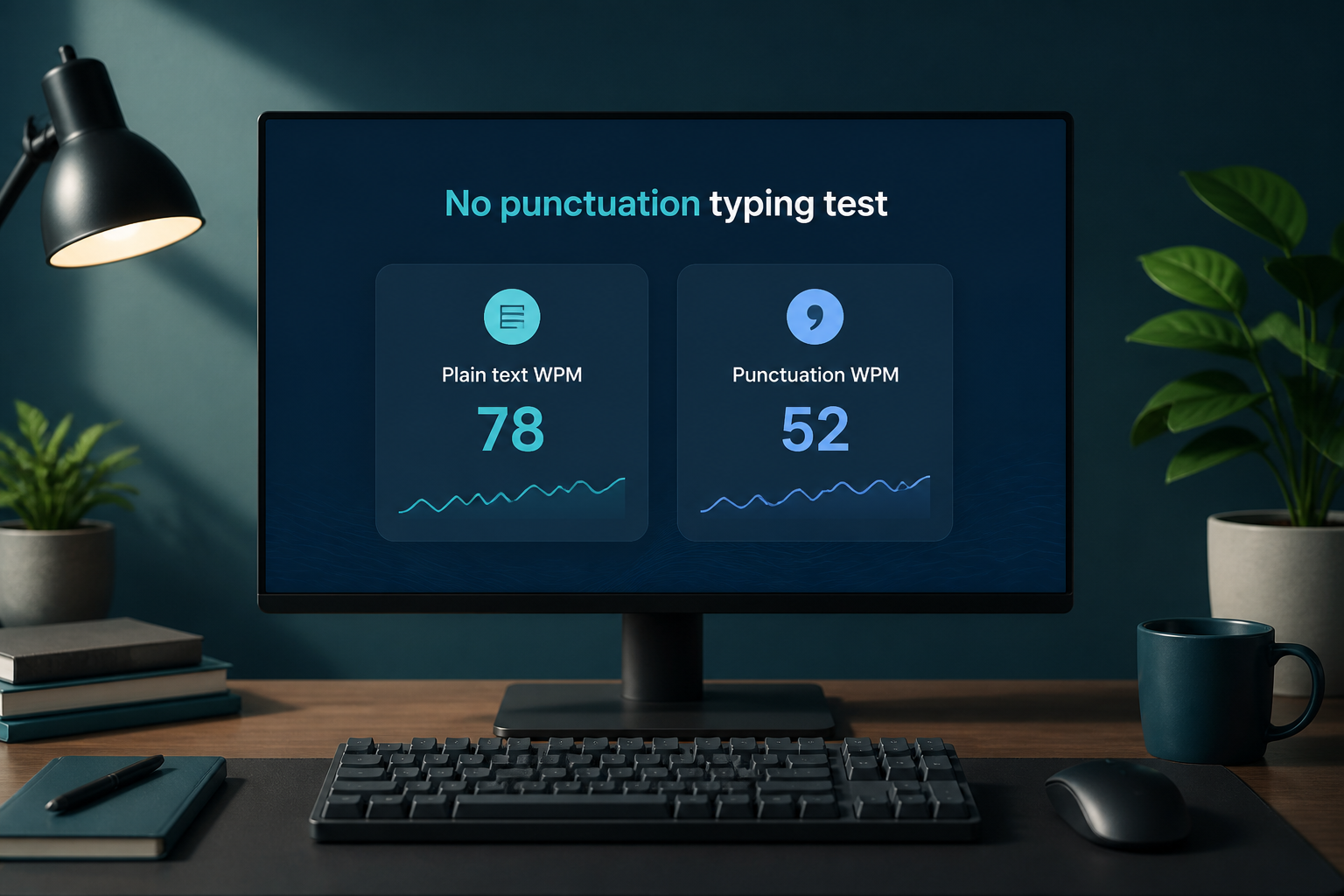
A no punctuation typing test measures how fast you type ordinary words when commas, periods, quotes, apostrophes, and symbols stay out of the way. Use it when you want a clean baseline for letter rhythm, spacing, and correction habits before you judge a full writing score. It will usually feel faster than a punctuation-heavy passage, but that does not make it fake. It answers a narrower question: how steady is your typing when the text does not ask for extra key reaches or shift timing?
# What a no punctuation typing test actually measures
A no punctuation typing test removes marks that interrupt plain word flow. The passage should still use normal words, mixed lengths, and realistic spacing. It simply avoids characters such as commas, periods, colons, quotes, parentheses, apostrophes, hyphens, and symbols.
That makes the result useful for three jobs:
- Finding your base letter speed.
- Measuring whether mistakes come from word rhythm or punctuation reaches.
- Building a repeatable warm practice round before harder passages.
It does not replace a standard typing test. Real writing includes punctuation, capitalization, numbers, and editing. If you only practice plain text, your WPM can rise while your email, code comment, or school note speed stays ordinary. The cleaner test works best as one layer in a small benchmark set.
TypeTest already gives you a quick way to run a normal baseline on the typing test. After that, compare your plain-text result with a harder passage from a typing speed test passage difficulty routine. The gap between those scores tells you more than either score alone.
# Use this test when punctuation is hiding the real problem
Punctuation changes a typing test because it adds decisions and reaches. A comma or period may be easy. A quote, colon, parenthesis, apostrophe, or question mark can require a shifted key, a different finger path, or a moment of visual confirmation. Good typists handle those details quickly, but they still change what the test measures.
Use a no punctuation typing test when your recent results show one of these patterns:
- Your WPM jumps around even when the passage length stays similar.
- Errors cluster around quotes, apostrophes, or end punctuation.
- You slow down before symbols, then overcorrect with a burst afterward.
- Your accuracy is high on simple text and messy on dialogue or code-like text.
- You want a low-friction baseline before a longer practice session.
Punctuation also affects readability and meaning. The Purdue OWL punctuation guide (opens new window) shows how many different jobs punctuation does in normal writing. A typing test with none of those marks measures motor flow more than sentence handling. That is useful, as long as you name it correctly.
# The clean speed comparison table
Run three short tests instead of treating one plain-text score as the whole truth.
| Test type | Passage rules | What it reveals | Use the result for |
|---|---|---|---|
| Plain text | Words and spaces only | Letter rhythm, spacing, basic correction habits | Clean WPM baseline |
| Light punctuation | Normal sentences with periods and commas | Sentence pacing and small pauses | Everyday writing comparison |
| Heavy punctuation | Quotes, apostrophes, numbers, symbols, or parentheses | Reach accuracy and shift timing | Targeted practice plan |
The goal is not to make the plain score match the heavy score. The goal is to understand the gap. A small gap means punctuation does not cost much. A large gap tells you where to practice next.
For example, a typist might score 82 WPM on plain text, 76 WPM on light punctuation, and 61 WPM on heavy punctuation. The clean baseline looks fine. The training target is punctuation handling, not general speed. Another typist might score 52, 50, and 48. That person should work on broad rhythm and accuracy before spending much time on symbol drills.
# How to run a fair 15 minute no punctuation typing test
Use a short protocol so the result holds up when you compare it next week.
- Pick a quiet setup and leave it unchanged for the full session.
- Run one normal typing test as a warmup, then ignore that score.
- Run three one minute no punctuation tests.
- Rest for 30 to 45 seconds between runs.
- Record WPM, accuracy, corrected errors, and uncorrected errors.
- Run one punctuation-heavy test after the plain rounds.
- Compare the median plain score with the punctuation-heavy score.
Use the median rather than your best score. Best scores invite accidental theater. The median tells you what you can reproduce.
Keep the passage rules strict. No punctuation means no punctuation. It should also mean no numbers, no emoji, no code snippets, and no names that act like puzzle words. If you want to practice long names, use a separate long word typing test. Mixing both ideas muddies the result.
# Score the gap, not just the WPM
The useful number is punctuation cost:
Punctuation cost equals plain-text WPM minus punctuation-heavy WPM.
Then read it with accuracy beside it.
| Punctuation cost | Accuracy pattern | Likely meaning | Next action |
|---|---|---|---|
| 0 to 5 WPM | Accuracy stays within 1 point | Punctuation is already stable | Keep mixed passages in rotation |
| 6 to 12 WPM | Accuracy drops 1 to 3 points | Shift timing or visual pauses cost speed | Add short punctuation ladders |
| 13 to 20 WPM | Accuracy drops more than 3 points | Punctuation is changing technique | Slow down and isolate mark groups |
| More than 20 WPM | Errors cluster around specific marks | Setup or habit problem is likely | Drill the worst marks separately |
This gap keeps you from drawing the wrong conclusion. If your plain score rises but punctuation cost grows, you are training around the hard part. If both scores rise and the gap stays steady, your general speed is improving. If the gap shrinks while plain WPM stays flat, your real writing speed may still improve because fewer pauses leak into normal work.
A WPM tracker helps here because you need a few weeks of results, not one heroic run. Track the passage type in the notes column. Future you will appreciate the breadcrumb trail, mostly because future you has a selective memory when a number looks flattering.
# Build passages that stay plain without becoming silly
Plain text should still look like something a person might write. Do not use a list of tiny words just because it creates a satisfying score. That measures sprint rhythm more than typing skill.
A useful passage has:
- Common words mixed with medium-length words.
- Natural sentence-like phrasing, even without punctuation marks.
- No rare proper nouns unless that is the training target.
- No repeated word patterns that become a rhythm game.
- Enough length to avoid memorizing the text by the second run.
Plain-language guidance can help you build readable practice text. The PlainLanguage.gov word choice guidance (opens new window) recommends familiar words when the goal is clarity. That works well for no punctuation tests because you want the typing task to stay about mechanics, not decoding.
Style guides also show why punctuation rules vary by context. The APA punctuation guidance (opens new window) and MLA punctuation notes (opens new window) cover marks that appear in academic writing. If your daily work includes essays or reports, add a punctuation-heavy round that reflects those marks after your clean baseline.
# Practice plan: plain text first, punctuation second
Use this four-day loop when your punctuation cost is more than 8 WPM.
Day 1: Baseline
Run the full 15 minute comparison. Record median plain WPM, punctuation-heavy WPM, accuracy, and the three most common error marks.
Day 2: Mark pairs
Practice only two punctuation marks for 10 minutes. Good pairs are comma and period, apostrophe and quote, colon and semicolon, or parentheses and hyphen. Keep speed low enough to stay above 97 percent accuracy.
Day 3: Mixed sentences
Run light punctuation passages. Aim for smooth reading and fewer hesitation pauses. Do not chase your plain-text WPM yet.
Day 4: Retest
Repeat the no punctuation test, then the punctuation-heavy test. Compare the gap. If plain speed improves but the gap stays large, keep punctuation drills. If the gap shrinks, return to mixed practice.
This plan separates rhythm from reach. Plain text builds momentum. Punctuation practice teaches control. Mixed sentences show whether the two skills can coexist without your hands staging a small procedural protest.
# When a no punctuation score misleads you
A plain-text score can mislead you when the test conditions are too narrow. Watch for these traps:
- You use the same passage repeatedly and start memorizing it.
- You ignore accuracy because the WPM looks pleasant.
- You compare plain-text WPM with someone else's standard WPM.
- You practice only short words and then struggle with normal paragraphs.
- You remove capitalization, punctuation, and numbers, then treat the result as real writing speed.
The fix is simple. Label the score. Write "plain text" beside it. Then pair it with a normal test and a harder test.
If you worry that shortcuts or setup changes are inflating your results, use the typing test hacks checklist before you trust a new personal best. Clean measurement saves time. It also prevents the classic loop where every new keyboard setting gets credit for one lucky run.
# Should you practice without punctuation every day?
Practice without punctuation for a specific reason, then rotate back to normal text. Daily plain-text work helps beginners build confidence and helps experienced typists warm up. It becomes limiting when it crowds out sentences that look like real work.
A balanced weekly split looks like this:
- 30 percent plain text for rhythm and warmup.
- 40 percent normal sentences for practical WPM.
- 20 percent punctuation-heavy passages for control.
- 10 percent specialty work, such as numbers, code, long words, or mobile typing.
Change the split when your gap changes. If punctuation cost drops below 5 WPM for two weeks, reduce the drills. If it climbs again, bring them back. The score should guide the practice, not decorate it.
# The simple takeaway
A no punctuation typing test gives you a clean view of letter rhythm, spacing, and basic correction habits. Use it as a baseline, then compare it with punctuation-heavy text so you can see what marks actually cost. The practical artifact is the gap: plain-text WPM minus punctuation-heavy WPM, read beside accuracy.
Run the three-test comparison on TypeTest, record the median instead of the best score, and keep the score label honest. Clean speed is useful when it helps you practice the next harder thing.